Friday, June 19, 2020
THE INDEXING STRATEGY IN NETWORKED SYSTEMS
Those of you who regularly send me what you think I need to read or see, thank you for being “my extended nervous system.”
THE INDEXING STRATEGY IN NETWORKED SYSTEMS
by Moritz Bierling
1/ Power in the Information Age is directly impacted by, and channeled through, information flow (access, control, manufacturing, manipulation, etc).
2/ In order to consistently gain access to good (useful) information, one has to do at least one, though usually more, of the following:
3/ - algorithmically and socially tune your existing network to consistently upregulate high signal and downregulate noise, which allows you to
4/ - consistently stumble upon sources outside your network displaying complexity of unfamiliar (to you) structure, which allows you to
5/ - consistently generate insight by engaging with actors and material that contrasts starkly with your existing mosaic of perspectives, which allows you to
6/ - develop your capacity to consistently make sense of an increasing variety and scope of situations (problems), both internal and external, which allows you to
7/ - consistently upregulate signal and downregulate noise in your network by
8/ - - selectively sharing other actor’s information (with/-out comments),
9/ - - commenting upon other actor’s information,
10/ - - and involving multiple unconnected actors in generative conversations, which allows you to
11/ - build up in other actors a psycho- and physiological expectation and perception of the continuation of your high signal activity, while at the same time
12/ - “placing listeners” in other actors (effectively extending your nervous system) for high signal content and the sources that produce them (they will see information and think “Moritz needs to know about this”, then tag or share accordingly), which allows you to
13/ - consistently improve the quality and quantity of information you have access to, which allows you to
14/ - consistently “sense” the dynamics, events, trends, movements, and other categories of developments both happening now and probable to happen in the (expanding) future, which allows you to
15/ - consistently act (read “allocate your attention and energy well”) and help/make/inspire others to act (ipso) in a way that “moves the needle” (to express it in a value neutral way).
16/ The strategy that I consistently observe as highly effective in kickstarting, maintaining, and accelerating the above sequence/process/system is the *indexing strategy*, which consists of
17/ - *procuring* (capture) high quality information from a diversity of sources in a central, private space, which allows you to
18/ - *processing* this information to further enrich its quality by way of
19/ - - emphasizing and deemphasizing its parts,
20/ - - contextualizing it by contrasting it with and relating it to other information,
21/ - - taking note of how your current emotional state and sense making process interact with it, and
22/ - - commenting upon it with recommendations for others for how to process it,
23/ - *producing* original and adapted information (content) for other actors’ consumption *in a structured way*,
24/ - *publishing* on a publicly accessible platform by specifically
25/ - - building and resurfacing (*placing*) again and again collections (threads, pages, documents) of content with shared characteristics (authors, themes, styles, methodologies, etc),
26/ - - inviting others to discuss there and contribute to them, thus
27/ - - becoming *the place where others go to learn*.
28/ Notice that this strategy is the structural engine and programmatic process by which all the power centers operate:
29/ - Google (search engine)
30/ - Facebook (people)
31/ - the Bible (look at the interconnectivity of passages, it’s the OG wiki)
32/ - news outlets (aggregators of “what’s happening” now failing due to weak business models and “what’s happening” becoming available elsewhere (social media)),
33/ - the brain (most complex structure we know of consuming least energy for highest output, working through opponent processing (competing clusters of cooperating neurons)),
34/ - the legal system (collections of code/rule sets constantly amended and extended)
35/ - corporations and conglomerates (complex systems of organizing natural, technological, and human resources through structures of ownership within interlocking circuits of two way value flows), and many others.
36/ The strategy works by *building interfaces* (think larger than screens) to the things we desire, want, need (and are made to desire, want, and need) by curating, indexing, overcoding, recombining, arranging, and (selectively and in a specifically structured way) displaying information.
37/ My friend Daniel Fraga calls the conscious construction of these systems “ontological design”.
38/ Some of the people I know who are most adept at variations of this strategy, each in their unique ways and to their specific ends, are Brandon Hayes, Alexander Kruel, Daniel Schmachtenberger, Jordan Hall, Jim Rutt, Rafe Kelley, Daniel Pinchbeck, Vinay Gupta, Michael John, Kurt Jensen, Tiago Forte, David Perell, Conor White-Sullivan, Gearóid Walsh, Visakan Veerasamy, and Curt Doolittle.
39/ To learn how to do this, nothing more is required of you than to pay close attention to your own motives and methodology in the steps and stages of this process (procure, process, produce, publish, place), conduct and learn from experiments, and adjust accordingly.
40/ For learning the technical (operative) fundamentals, I specifically recommend Tiago’s course “Building a Second Brain” and David’s course “Write of Passage” as well as their free materials.
41/ For information on the greater ecology of information, I recommend the sense making series by David Fuller and Alexander Beiner of Rebel Wisdom, Jordan Hall’s Situational Assessments on Medium, Pat Ryan’s Dark Stoa series, and my own presentation on memes (search for “Moritz Bierling decentralized culture” here on Facebook or on YouTube).
42/ Comment below for discussions of each of these points and requests for pointers to more material, or DM me for conversation unsuited to a (semi-)public forum.


Wednesday, June 17, 2020
Free Space Laser Communications 35 Miles - June 1993 - AM Video and PWM Audio


Eric Lee with home made Free Space Laser Communication gear.
35MM camera lenses used to collimate IR laser diodes and Telescopes with Avalanche photodiodes to receive data.
The Link was actually established June of 1993 between Mt Hamilton and Fremont Peaks at total of 35 Miles, Both Infra-red and Visible laser diodes were uses to transmit PWM voice and attempted video.
I actually got my Amature Radio licence just to be able to officially log our communication. KE6BYN.
Subject: Laser communications experiment performed between Fremont Peak State Park and Lick Observatory on Mount Hamilton
Lasers used:  20 milliwatt diode laser, 685 nm
              30 milliwatt diode laser, 830 nm
              beam divergence 1 milli radian

propagation path length  48 kilometers          D
visual range  20 - 100 km                       V
beam power                                      P
tangent(divergence angle)                       T
Rayleigh scattering coefficient                 R
Mie scattering coefficient                      M
wavelength                                      l


Geometric divergence:

power density = 4P/(3.14(T^2)(D^2))

              = 1.1 * 10^-9 watts/cm2   at 685 nm

              = 1.6 * 10^-9 watts/cm2   at 830 nm

Atmospheric path loss:

Rayleigh coefficient  R = 0.00833*(l/600)^-4.08

                        = 4.9 * 10^-3  km^-1  at 685 nm

                        = 2.2 * 10^-3  km^-1  at 830 nm

Mie coefficient       M = (3.91/V)*(l/550)^((-0.585)*(V^0.3))

                        = 0.14 to 0.023   km^-1   at 685 nm

                        = 0.11 to 0.015   km^-1   at 830 nm

visual range of 20 to 100 km, considered to correspond to

"clear" and "extremely clear" transparency
conditions

percent transmission = e^-(M+R)D

                     = 9.5 * 10^-4  to  2.6 * 10^-1   at 685 nm

                     = 4.6 * 10^-3  to  4.3 * 10^-1   at 830 nm

Maximum power density at Lick Observatory:
(power density)*(percent transmission) =

       = 2.9 * 10^-10 watts/cm2    at 685 nm

                     = 6.9 * 10^-10 watts/cm2    at 830 nm
Sadly Eric Passed away May, 2018 .
https://quelab.net/19535/memorial-and-celebration-of-life-for-eric-lee/
https://today.slac.stanford.edu/feature/2007/profile-eric-lee.asp
https://www.researchgate.net/scientific-contributions/8490440_Eric_R_Lee
https://books.google.com/books?id=HgJ-DwAAQBAJ&lpg=PT33&ots=sDrMWNDjYC&dq=eric%20lee%20dark%20matter&pg=PP1#v=onepage&q=eric%20lee%20dark%20matter&f=false
Audio Byte - Parallel Port R2R Audio Adapter, Photos of Prototypes.


These were Aluminum jigs I made to hold the 18 resistors in place while we soldered them together without a PCB. We made 3000 units this way.
These 18 Resistors formed an R-2R network. In my case I chose 50K Ohm and 100K Ohm.


AudioByte, Amiga Mod files and Chip Tunes.
It all comes full circle.
All that stuff Jesse Monroy and myself did 30 years back,


AudioByte (Originally Sound Byte)
The Original Parallel Port Dongle audio adapter.

Editor and Mod file players in Intel x86 assembly code.
More at: http://www.dnull.com/zebraresearch/
https://github.com/johnsokol/AudioByte
Now I stumble on WebAssembly and OpenGL and realize I have more power in a browser tab than I had on the $250,000 4 cpu SGI workstation at stanford.
Certainly dwarfing the 10 Mhz 286 I had in those days.
Then I found chiptunes. This is super cool.
These guys are mad crazy about video game emulators and reproducing the hardware faithfully.
https://deskjet.github.io/chiptune.js/ A player you can drop Amiga Mod files on and play them.
http://www.dnull.com/mod/files.html My mod file collection.
http://www.dnull.com/mod/files.html My mod file collection.
And the new version, not as good.
https://deskjet.github.io/chiptune2.js/#
https://deskjet.github.io/chiptune2.js/#
But this is WOW!!!! it's like wow. A universe unto itself.
https://mmontag.github.io/chip-player-js/browse/ModArchives?play=ModArchives%2Faws_aq16.xm
Best part it's all open source and hosted free of charge on github.
Tuesday, June 16, 2020

Friday, April 17, 2020


Wednesday, April 15, 2020
Thoughts on world population

Arthur C. Clarke had a story inspired by the Dalai Lama,
Nine Billion Names of God.
https://en.wikipedia.org/wiki/The_Nine_Billion_Names_of_God
We actually where trying to raise money to produce a movie back in 2008.
https://youtu.be/M5ddHs5VKqA
Nine Billion Names of God.
https://en.wikipedia.org/wiki/The_Nine_Billion_Names_of_God
We actually where trying to raise money to produce a movie back in 2008.
https://youtu.be/M5ddHs5VKqA
I honestly believe there is a massive consciousness change that will occur around that population number, also called the Singularity and described many different ways in ancient texts.
We are expected to hit 9,000,000 somewhere between 2035 and 2040 as well as human level AI in this same time window.
Kurzweil believes that the singularity will occur by approximately 2045.
We are expected to hit 9,000,000 somewhere between 2035 and 2040 as well as human level AI in this same time window.
Kurzweil believes that the singularity will occur by approximately 2045.
https://aiimpacts.org/predictions-of-human-level-ai-timeli…/
Notice the wisdom of the crowds effect where the average of the predictions will most likely be spot in.
Notice the wisdom of the crowds effect where the average of the predictions will most likely be spot in.
The transition is one, where if you think of each Human as Neuron's (Nodes) in a giant communications network, we reach a critical number where in effective, we wake up and reach as a species a new and profound level of awareness. One that will change us in to an entirely net species.
One with AI enhancements, the ability to control our DNA and generics in direct our evolution in unforeseeable ways, but basically leave earth to conquer the galaxy and beyond.
Assuming we can get there. Or do we fail in die in a breech birth of sorts. Extinguishing our species only to let some new creatures make a go of it in a few million years?
I feel there are those among us activity working against us reaching our full potential. By subsidizing pollution and unsustainable practices, advocating population reduction, killing and stifling innovations.
Any cells that are out for just themselves in the living animal are called cancers and will destroy the whole creature. These cells become immortal and reproduce and consume resources unchecked.
Friday, March 27, 2020
AIZU×DEAIs 2019 Edition E - YouTube
---------- Forwarded message ---------
From: Michael Cohen
From: Michael Cohen
Hi, John.
I believe that is you featured in the still @ 7:58 of this video:
BTW, my own lab has a hoverboard and a Segway.
I hope you get a chance to ride them!
Saturday, March 07, 2020
Monday, April 22, 2019
Friday, April 05, 2019
Livecam business plan from 2001
http://www.dnull.com/~sokol/Camera1/Camera1.htm
Blogger will just not let me copy this document in to the blog.
Disclaimer:
The information in the following document is a first draft and has not reviewed for it accuracy; its still being modified on a daily bases.
Nothing in this document should be considered a statement of fact and its author John L. Sokol has been it’s only contributor up to this point.
John L. Sokol or any companies, corporation or organizations make no guarantees to this documents accuracy and by reading past this, you agree to not holding the above or any other parties responsible for anything contained or inferred in this document.
The information within this document is considered proprietary by
John L. Sokol and it is requested that this not be distributed or disclosed to any other parties without his consent.
Information
Copyright ©
John L. Sokol
10/5/2001
Livecam Digital Camera System
Surveillance, Conferencing, Video logging
By John L. Sokol
Pre-draft Version 10/08/2001
The mini Livecam™ camera and its applications.
Usually when you think high tech and Internet video the last think you think of is security cameras and surveillance. It’s not very sexy, some guy making minimum wage in a blue uniform sitting behind a bank of CRT’s. It’s a technology that’s been around since the 50’s and it is a very large and well-established market. This market is just starting to feel the impact of the digital revolution let alone the Internet. This is where it gets interesting because the advances in compression, image processing and recognition, AI (Artificial Intelligence), face recognition and broadband are going to revolutionize the entire security industry.
This change will be bad for some and good for other. Many of these companies are still in the Stone Age and barely know what a computer is. This great for a new high tech company as long as they keep this in mind. Not only is the competition in this backward mindset but also are the customers. The key here is not to make the mistake I have seen so often, a low tech customer base intimidated by a wiz bang gadget that will do one thousand and one thing and not one person can figure out how to make it perform basic functions.
This is where the Livecam has always shined, proving the latest and most advance compression and technology inside the box while at the same time keeping the outside familiar, reliable and dirt simple fool proof. Use of standard and familiar connectors for those who already know analog video, a simple web page to access and instantly they are up and streaming live video. The new product design is also that same way. It’s simple and modular allowing those with little technical ability to set it up and those with greater skills to be able to use this as the building block of very powerful system.
History of the Livecam and
Companies surrounding it.
Livecam has a long history for an Internet technology. John Sokol had participated in some very early streaming audio experiments over the internet in 1988 and later streaming video at Sun Microsystems in 1991.
The very first Livecam was created in 1995 for Tahiti.com to place Livecams at tourist locations on the Tahitian Islands, this was done jointly with FountainHead Internet Systems. From there, the Yosemite Livecam was place at Glacier Peek and recorded its collapse in 1996 for Internet Outfitters and Yosemite.org . Many Livecams were placed around the country, most would only capture an image every minute or so and place it on a web site.
This work was done under the name Sokol and Associates. S&A had been involved with many advanced Internet projects; it had over 60 costumers with many with very close working relationships. One was with the first Streaming video company Xing with their Streamworks product. Xing was later purchased by Real Video for $78M.
S&A spun out, or was part of several companies, Netsys inc, Symatrix, Process Network Productions, Omnetrix, Light Entertainment, (DVT) Digital Video Technology, and (IBS) Internet Broadcast Systems. NetSys (short for Network Systems) was to deploy a Distributed Serving Network called SDSN in Early 96 it only received partial funding and was later acquired by IBS.
Internet Broadcast Systems deployed a large video rebroadcast network for early Internet customers that were able to charge for video. IBS started with a customize version of the Xing product developed by Sokol. Very quickly be became clear there were problems with Xing product and the Livecam was redesigned to replace Xing as something much more scalable and reliable. At one point over 10,000 views we observer at one time watch Livecam video. IBS funded S&A and DVT to experiment with many different video-streaming technologies. From this the record breaking Afterburner was created. A streaming Wavelet Video was created, Streaming Fractal video, as well as an early MPEG-4 solution that is still plays current MPEG-4 files better then many current players. The Livecam was the simplest and most straightforward of all the solutions and was found to work best in the real world environments. With further development it was achieving almost the same compression ratios as more sophisticated compression scheme while still remaining compatible with the JPEG Standard.
In 1998 IBS became DVBS as part preparations for becoming a Pink Sheet and later a publicly traded company on the VSE (Vancouver Stock Exchange) (Symbol IMVC). In 1999 DVBS California was created and development was moved to San Jose California. At this time the Livecam video Conferencing features were added, performance and picture quality continued to improve and the user interface became much simpler to use. DVBS acquired several companies, Sirex USA, and FutureTech International. In 2000 DVBS began to have funding problems and split apart, the public entity became Pervasys Inc. (Symbol PVYS) and continues to sell a product similar to the Livecam called Felix.
Current Status
John Sokol, still retaining all his intellectual property went separately and started Zydeo Inc. with new partners in August of 2000. Zydeo so far has not raise money or completed a business plan. The board of Zydeo has agreed to either restructure the company, diluting the original shareholders or allow Zydeo to be acquired by a new company for a small percentage.
The Current Livecam as well as some competing products can be seen at
http://www.videocomplex.com/products/main.asp?menu_id=02&type=cate&s_currency=1&cartid=6498&mode=setup
Economics of Internet Video
Economics of Internet Video

Figure (1) Cost for sending video and audio.
After 10 years of toiling with video over the Internet I began to realize a few things. Most people want to do something “Glamorous”. They think TV stations over the Internet, Independent films or radio stations. Often they just don’t have the content to attract paying customers. They want to provide content for free and pay for it with advertising and sponsorships.
Costs
Looking at Figure (1) the cost of Internet video and audio starts off low. Many people think this is a great opportunity just a few thousand dollars and they have a global TV network just like the CNN or AT&T. But on several occasions I have seen this type of thinking, very quickly turn into a nightmare of bandwidth bills. The problem is the way the Internet revenue model works. This is where the send and receiver each pay their upstream ISP for their share; in some sense it’s like a 50/50 Split. Senders (servers / content providers) pay their halve and receivers, the guy at home, pays his $20 a month. Each viewer cost the provider only a few cents to send a video; this is happening 24 Hrs a day 7 days a week 365 days a year and quickly adds up.
Even if it’s 10 cents an hour, per viewer, this is $72 per viewer per month. By each viewer I mean one allocation of resources for a viewer to connect into. This is equivalent to a seat in a restaurant; one seat may have many occupants over the course of a day but only one at a time.
So for 100 (seats) viewers it’s $7200 a month. For 10000 viewers it $720,000 per month, at this point renting air time for infomercials on cable starts to look very cost effective. The other problem is even if you transmit one hour per week to 10,000 viewers, you still need the whole bandwidth, flat rate as if you were broadcasting continuously. Just as you would to seat 10,000 people in a theater you need to build out the theater and pay the full month rent on the building.
The economics just don’t scale up for Internet video. Currently Internet video can only compete where there are a small number of viewers.
Why to choose security and video conferencing?
Based on Figure (1),
The applications where Internet Video makes economic sense is:
1.) Markets with only a small number of viewers
2.) Markets where people pay to view.
Security and video conferencing fit the first scenario.
This is the market I have decided to pursue and have designed the new product to address the needs of these specific markets.
Education, adult, gambling, special events such as football fit the second.
These are complicated and depend entirely on producing or having access to video or music content.
Video Conferencing could also be used in the second scenario as well but it seems like a difficult market logistically with a large capital outlay.
Another technology option is to use Peer-to-Peer transmission technology elimination the provider’s cost of bandwidth. I have research this to a great extent and found that even with the broadband connectivity available today, the upstream wasn’t sufficient for video, but was fine for just low bandwidth audio transmission. Also there are complication being created with firewalls and NATS (Network address translators) that are used to allow multiple computers on a DSL connection. Although, there may still be an opportunity here.
Analysis of the Video Camera Market.
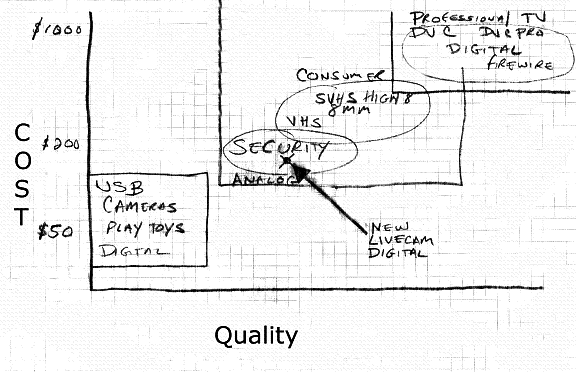
Currently in the Medium quality, mid-range there only exists analog video systems. Digital is both low cost and low quality or high cost ultra high quality with little in the middle ground. There seems to be no digital solution with adequate quality for security camera use and that is still cost effective.
This is where I plan to place the new Livecam camera product, the only midrange digital solution that beats the “disposable USB Cameras” and provides an industrial grade security solution while still being sellable into business and consumer markets for a higher quality of video conferencing then is available today.
Even if the low cost cameras like the USB or a connectix QuickCam deliver better video it’s not compressed output and they require a $1000 Windows PC to connect to and convert the video into an Internet format. Currently it’s only the very high end DVC equipment that included the video compression electronics to be able to save 1 Hr of digital video to a tape.
The Wireless World
 | 
Figure (3) Xcam2 Wireless Video Camera with built-in Video Transmitter
|
Product Misperceptions
The X10 camera that has been seen all over the web with these new annoying pop up from behind ads. There are great little cameras, but they are not digital. These X10 cameras are analog video cameras with analog wireless radio links and have nothing to do with the Internet video. They are another security product that is selling like crazy. It’s one of the few consumer grade security products and before their very effective Internet marketing blitz they were having a very difficult time selling them.
It’s funny because most people perceptions still are they can send video over the Internet with the Xcam2 product. To do this you will still need to use a Livecam or similar to convert and compress the video to a Internet format. I have used these X10 cameras with the Livecam on many occasions to eliminate having to dangle wires across a room or get into difficult to access locations.
Importance of Wireless
This brings up a very valid point. Wireless is an important technology and can simplify the installation of surveillance systems to a large extent. The new Livecam product is designed to connect to standard Ethernet networks. There is an 802.11 wireless Ethernet standard that is very quickly dropping in price and increasing in popularity. Some future models of the Livecam camera will have 802.11 (DSSS, wireless Ethernet) support build in thereby being 100% identical in operation to the wired version but operating wireless. In this version a third Party wireless card will just be added internally to the camera.
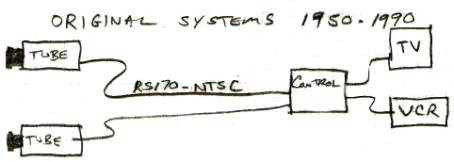
Figure (4) Older CCTV (Closed Circuit Television System)
Cameras technologies have improved over time.
- Black and white tube
- Color multiple tubes
- Color single tube
- Black and while CCD (Charge Coupled Device) a silicon chip
- Color CCD
Coming soon is:
- Color CMOS – cameras build using digital silicon chip process
- Color CMOS all digital output, USB cameras do this now but the image quality is not there yet.
The technology for 6 and 7 is still being worked out, I would very much see this company eventually make a #7 based product where there is nothing but a chip with a lens and network connections coming out of it. This would be the ultimate in low cost.
Until the mid 80’s there was little improvement in the rest of the system.
VCR’s came in the 70’s but these are just modified consumer VCR’s that move the tape slower and cause severe reduction in picture quality. Most systems still use this.
Also the addition of a control/effect box allowed one TV to display 4 cameras at one and also allow the rotation of multiple camera images to cycle through an even larger number of attached cameras.
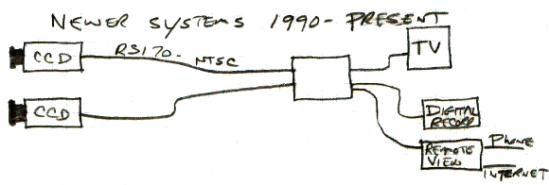
More recently digital recorders have become available. These are like the consumer TiVo product that store compressed video on a hard disk drive. These units can run from $1200 to $20,000. Most are based on Intel PC computers and some even run windows inside.
Most of the lower cost recorders claim full motion and support for several cameras at once, but when evaluating these I found as soon as you have more then one camera the video drops to a image per second or lower. This is more like a slide show.
Most will not transmit video over the Internet and there are separate boxes that support this. The older Livecam product can be consider one of these, even though it has superior image video quality then the competition, its higher price, larger size and appearance as a desktop PC has limited sales into the security industry. The new Livecam camera rectifies all of these issues.

Figure (6) Livecam Camera in and All Digital CCTV Security System
- A – All Digital Cameras connected directly to network.
- B – Typical Ethernet LAN Hub to interconnect all network devices.
- C -- Windows Based PC can allow viewing of cameras or recording
- D – Unix server can allow conversion of digital video to Analog TV and also record digital video.
- E – A standard TV or Analog CCTV Security Monitor or Computer VGA Monitor
- F – Same as D except connected over the public Internet
- G – Same as C except connected over the public Internet
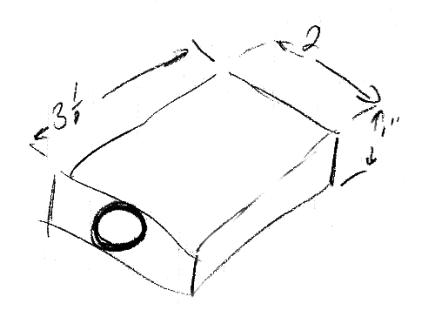
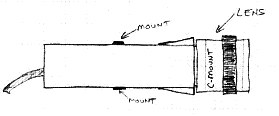
Size of proposed new video solution. In Inches.
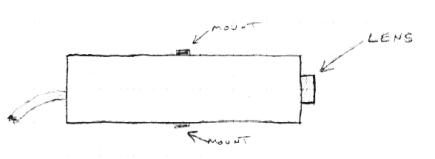
Version with built-in cheap plastic lens.
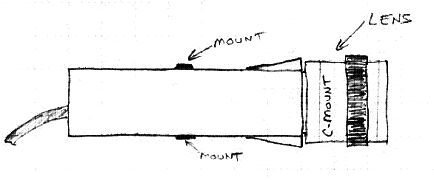
C-mount removable lens version. Customers can select their own lenses.
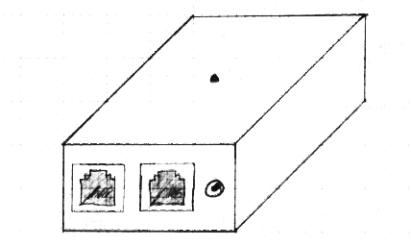
Rear view of unit, Notice 2 x 10-BaseT Ethernet Network connectors and power.
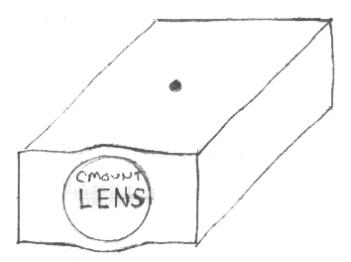
Front view of C-mount version.
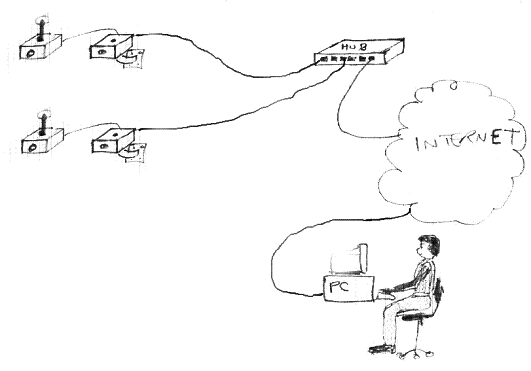
This is a bad drawing I did to show a typical system setup.
Notice how the cameras are in a daisy chained or start configuration and attach them directly to a network hub and directly onto the Internet.
Articles:
Just a Search for the word “Surveillance” in Red Herring still needs to be filtered.
Date and Source
|
Title
|
Topic Area
|
09/19/2001 Red Herring
|
Catch of the Day
| |
09/11/2001 Red Herring
|
Technology
| |
08/06/2001 Red Herring
|
Investor
| |
08/01/2001 Red Herring
|
Magazine
| |
05/01/2001 Red Herring
|
Venture Capital
| |
04/27/2001 Red Herring
|
Venture Capital
| |
04/25/2001 Red Herring
|
Venture Capital
| |
04/23/2001 Red Herring
|
Venture Capital
| |
04/20/2001 Red Herring
|
Venture Capital
| |
04/11/2001 Red Herring
|
Investor
| |
04/03/2001 Red Herring
|
Venture Capital
| |
02/15/2001 Red Herring
|
Technology
| |
02/06/2001 Red Herring
|
Venture Capital
| |
01/18/2001 Red Herring
|
Technology
| |
01/16/2001 Red Herring
|
Technology
| |
01/01/2001 Red Herring
|
Technology
| |
11/20/2000 Red Herring
|
Venture Capital
| |
11/01/2000 Red Herring
|
Magazine
| |
11/01/2000 Red Herring
|
Magazine
| |
10/16/2000 Red Herring
|
Venture Capital
| |
09/19/2000 Red Herring
|
Venture Capital
| |
08/01/2000 Red Herring
|
Magazine
| |
05/01/2000 Red Herring
|
Magazine
| |
03/01/2000 Red Herring
|
Magazine
| |
01/01/2000 Red Herring
|
Magazine
| |
04/01/1999 Red Herring
|
Magazine
| |
03/01/1998 Red Herring
|
Magazine
| |
01/01/1998 Red Herring
|
Magazine
| |
12/01/1997 Red Herring
|
Magazine
| |
12/01/1997 Red Herring
|
Magazine
| |
08/01/1997 Red Herring
|
Magazine
| |
08/01/1995 Red Herring
|
Magazine
| |
07/01/1995 Red Herring
|
Magazine
| |
04/01/1995 Red Herring
|
Magazine
|
COMPANIES
 Visionics (face recognition)
Viisage (face recognition)
Identix (fingerprint recognition)
Iridian Technologies (iris recognition)
EyeTicket (iris recognition)
Keyware (various biometrics)
BioNetrix (biometrics application platform)
Ankari (security and authentication)
RSA Security (authentication and data security)
Visionics (face recognition)Viisage (face recognition)Identix (fingerprint recognition)Iridian Technologies (iris recognition)EyeTicket (iris recognition)Keyware (various biometrics)BioNetrix (biometrics application platform)Ankari (security and authentication)RSA Security (authentication and data security)
RELATED STORIES
Heard from the Buy Side: Identix proves itself
John Hancock goes digital
Catch of the Day: Ticket turbulence
Catch of the Day: Freedom and information
Market Currents: You are not powerless
Catch of the Day: Emergency broadcast network
Heard from the Buy Side: Identix proves itself John Hancock goes digital Catch of the Day: Ticket turbulence Catch of the Day: Freedom and information Market Currents: You are not powerless Catch of the Day: Emergency broadcast networkAppendix
Adds of other competing technologies.
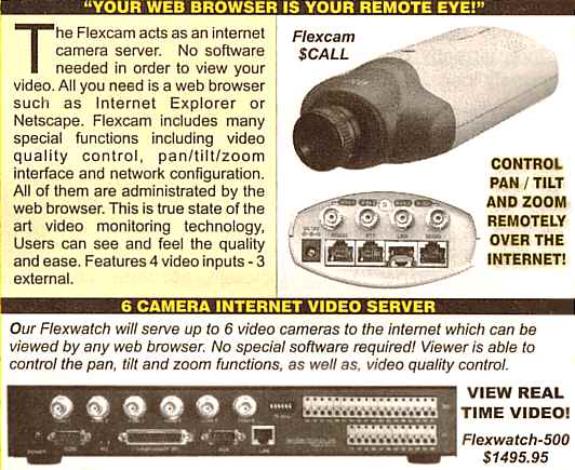
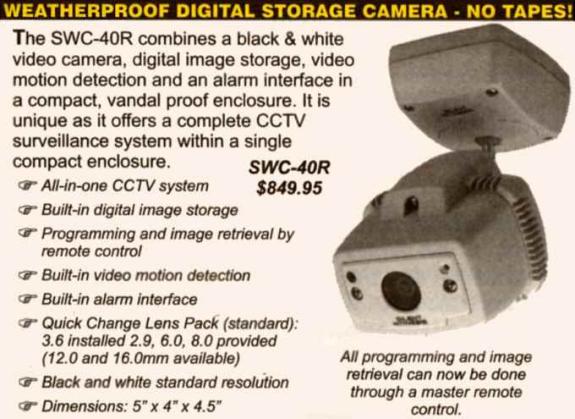
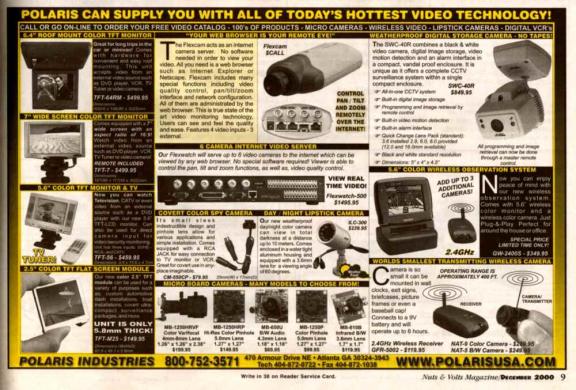
From www.videocomplex.com
The Livecam in this page is the old Zydeo Livecam product.
| 
| |||||||||


 |
LIVECAM 1.0 VIDEO/AUDIO STREAMING SERVER [LSX-01]
|
The OPTICOM LSX-01 is a broadcast quality streaming audio/video server. With Broadband Technology becoming a dominant force in the marketplace, it is important to make sure that users are able to utilize technology like the LSX-01. Because the LiveCam video stream is actually Live, and the applet is delivered concurrently with the stream, the LiveCam video stream can be utilized in unique ways currently unachievable with traditional streaming systems.
The LiveCam operates on cross platform, all makes of PC's and Apple/Mac computers can accept and view the stream. Live video and audio can be e-mailed to opt-in mailing lists, allowing the user to see video right from their Eudora or Outlook Express mail program.
The LiveCam can be used as a powerful marketing tool as the stream can be integrated into hundreds of banner adds across the web to increase click-throughs and regular site visits. The LiveCam will support hundreds of simultaneous users with no video or audio loss. The "real-time" aspect also allows for web based "interactivity" on a new level: Remote control devices, mass internet marketing, and videoconferencing are just a few examples. |
 |
WEBEYE ALL-IN-ONE HIGH SPEED CAMERA SERVER [WE-10]
|
The Webeye™ WE-10 is an integrated camera and video streaming server all in one attractive unit. The Linux based Web-server combines high speed networking technology with a 1/3" format CCD camera. In addition to this, the WE-10 is equipped with a 32bit RISC CPU, making it even more efficient in processing images. The WE-10 utilizes a High-Speed Internet connection (ie. Cable modem, ADSL, T-1) by connecting directly into the Ethernet and providing live motion color pictures via the Internet.
The WE-10 generates pictures in Wavelet format, which is a more efficient, by 30-300%, compression system than standard JPEG. By utilizing the Internet, the user can save expensive long-distance charges often associated with PSTN modem-to-modem dial-up connections, while still able to have real-time monitoring of live video.
|
This lists “which is a more efficient, by 30-300%, compression system than standard JPEG”
In tests this is much less efficient then the original Livecam product requiring more bandwidth to achieve the same frame rates and image quality then Livecam was using. In addition they have a low profit margin because they have had to embed and entire windows PC inside their camera.
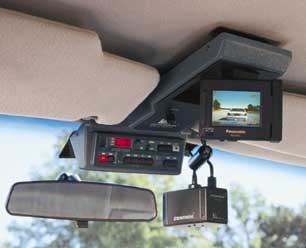
http://www.kustomsignals.com/
http://www.kustomsignals.com/product_body2.asp?product_id=11&cat_id=9&strpagename=video
http://www.kustomsignals.com/product_body2.asp?product_id=11&cat_id=9&strpagename=video
 |
|
 | ||||||||
» Products » Network Camera and Video Servers
|
| ||

Subscribe to:
Posts (Atom)