Friday, April 05, 2019

Livecam business plan from 2001


http://www.dnull.com/~sokol/Camera1/Camera1.htm

Blogger will just not let me copy this document in to the blog. 

Disclaimer:

The information in the following document is a first draft and has not reviewed for it accuracy; its still being modified on a daily bases.

Nothing in this document should be considered a statement of fact and its author John L. Sokol has been it’s only contributor up to this point.

John L. Sokol or any companies, corporation or organizations make no guarantees to this documents accuracy and by reading past this, you agree to not holding the above or any other parties responsible for anything contained or inferred in this document.

The information within this document is considered proprietary by
 John L. Sokol and it is requested that this not be distributed or disclosed to any other parties without his consent.


Proprietary

Information


Copyright ©
John L. Sokol
10/5/2001


Livecam Digital Camera System

Surveillance, Conferencing, Video logging


By John L. Sokol
Pre-draft Version 10/08/2001


The mini Livecam™ camera and its applications.


            Usually when you think high tech and Internet video the last think you think of is security cameras and surveillance. It’s not very sexy, some guy making minimum wage in a blue uniform sitting behind a bank of CRT’s. It’s a technology that’s been around since the 50’s and it is a very large and well-established market. This market is just starting to feel the impact of the digital revolution let alone the Internet. This is where it gets interesting because the advances in compression, image processing and recognition, AI (Artificial Intelligence), face recognition and broadband are going to revolutionize the entire security industry.

            This change will be bad for some and good for other.  Many of these companies are still in the Stone Age and barely know what a computer is. This great for a new high tech company as long as they keep this in mind. Not only is the competition in this backward mindset but also are the customers.   The key here is not to make the mistake I have seen so often, a low tech customer base intimidated by a wiz bang gadget that will do one thousand and one thing and not one person can figure out how to make it perform basic functions.

This is where the Livecam has always shined, proving the latest and most advance compression and technology inside the box while at the same time keeping the outside familiar, reliable and dirt simple fool proof. Use of standard and familiar connectors for those who already know analog video, a simple web page to access and instantly they are up and streaming live video. The new product design is also that same way. It’s simple and modular allowing those with little technical ability to set it up and those with greater skills to be able to use this as the building block of very powerful system.


History of the Livecam and
Companies surrounding it.

Livecam has a long history for an Internet technology.  John Sokol had participated in some very early streaming audio experiments over the internet in 1988 and later streaming video at Sun Microsystems in 1991.

  The very first Livecam was created in 1995 for Tahiti.com to place Livecams at tourist locations on the Tahitian Islands, this was done jointly with FountainHead Internet Systems. From there, the Yosemite Livecam was place at Glacier Peek and recorded its collapse in 1996 for Internet Outfitters and Yosemite.org .  Many Livecams were placed around the country, most would only capture an image every minute or so and place it on a web site.

 This work was done under the name Sokol and Associates. S&A had been involved with many advanced Internet projects; it had over 60 costumers with many with very close working relationships. One was with the first Streaming video company Xing with their Streamworks product. Xing was later purchased by Real Video for $78M.

S&A spun out, or was part of several companies, Netsys inc, Symatrix, Process Network Productions, Omnetrix, Light Entertainment, (DVT) Digital Video Technology, and (IBS) Internet Broadcast Systems.  NetSys (short for Network Systems) was to deploy a Distributed Serving Network called SDSN in Early 96 it only received partial funding and was later acquired by IBS.

Internet Broadcast Systems deployed a large video rebroadcast network for early Internet customers that were able to charge for video. IBS started with a customize version of the Xing product developed by Sokol.  Very quickly be became clear there were problems with Xing product and the Livecam was redesigned to replace Xing as something much more scalable and reliable. At one point over 10,000 views we observer at one time watch Livecam video. IBS funded S&A and DVT to experiment with many different video-streaming technologies. From this the record breaking Afterburner was created. A streaming Wavelet Video was created, Streaming Fractal video, as well as an early MPEG-4 solution that is still plays current MPEG-4 files better then many current players. The Livecam was the simplest and most straightforward of all the solutions and was found to work best in the real world environments. With further development it was achieving almost the same compression ratios as more sophisticated compression scheme while still remaining compatible with the JPEG Standard.

 In 1998 IBS became DVBS as part preparations for becoming a Pink Sheet and later a publicly traded company on the VSE (Vancouver Stock Exchange) (Symbol  IMVC).  In 1999 DVBS California was created and development was moved to San Jose California. At this time the Livecam video Conferencing features were added, performance and picture quality continued to improve and the user interface became much simpler to use.  DVBS acquired several companies, Sirex USA, and FutureTech International. In 2000 DVBS began to have funding problems and split apart, the public entity became Pervasys Inc. (Symbol PVYS) and continues to sell a product similar to the Livecam called Felix. 


Current Status

   John Sokol, still retaining all his intellectual property went separately and started Zydeo Inc. with new partners in August of 2000.  Zydeo so far has not raise money or completed a business plan. The board of Zydeo has agreed to either restructure the company, diluting the original shareholders or allow Zydeo to be acquired by a new company for a small percentage.


The Current Livecam as well as some competing products can be seen at 


Figure (1) Cost for sending video and audio.

After 10 years of toiling with video over the Internet I began to realize a few things. Most people want to do something “Glamorous”. They think TV stations over the Internet, Independent films or radio stations. Often they just don’t have the content to attract paying customers. They want to provide content for free and pay for it with advertising and sponsorships.

Costs

Looking at Figure (1) the cost of Internet video and audio starts off low. Many people think this is a great opportunity just a few thousand dollars and they have a global TV network just like the CNN or AT&T. But on several occasions I have seen this type of thinking, very quickly turn into a nightmare of bandwidth bills. The problem is the way the Internet revenue model works. This is where the send and receiver each pay their upstream ISP for their share; in some sense it’s like a 50/50 Split.  Senders (servers / content providers) pay their halve and receivers, the guy at home, pays his $20 a month.  Each viewer cost the provider only a few cents to send a video; this is happening 24 Hrs a day 7 days a week 365 days a year and quickly adds up.

Even if it’s 10 cents an hour, per viewer, this is $72 per viewer per month. By each viewer I mean one allocation of resources for a viewer to connect into. This is equivalent to a seat in a restaurant; one seat may have many occupants over the course of a day but only one at a time.
So for 100 (seats) viewers it’s $7200 a month.  For 10000 viewers it $720,000 per month, at this point renting air time for infomercials on cable starts to look very cost effective.  The other problem is even if you transmit one hour per week to 10,000 viewers, you still need the whole bandwidth, flat rate as if you were broadcasting continuously. Just as you would to seat 10,000 people in a theater you need to build out the theater and pay the full month rent on the building.
  The economics just don’t scale up for Internet video.  Currently Internet video can only compete where there are a small number of viewers.


Why to choose security and video conferencing?


Based on Figure (1),
The applications where Internet Video makes economic sense is:
1.)    Markets with only a small number of viewers
2.)    Markets where people pay to view.

Security and video conferencing fit the first scenario.
This is the market I have decided to pursue and have designed the new product to address the needs of these specific markets.

Education, adult, gambling, special events such as football fit the second.
These are complicated and depend entirely on producing or having access to video or music content.

Video Conferencing could also be used in the second scenario as well but it seems like a difficult market logistically with a large capital outlay.

Another technology option is to use Peer-to-Peer transmission technology elimination the provider’s cost of bandwidth. I have research this to a great extent and found that even with the broadband connectivity available today, the upstream wasn’t sufficient for video, but was fine for just low bandwidth audio transmission. Also there are complication being created with firewalls and NATS (Network address translators) that are used to allow multiple computers on a DSL connection. Although, there may still be an opportunity here.


Analysis of the Video Camera Market.
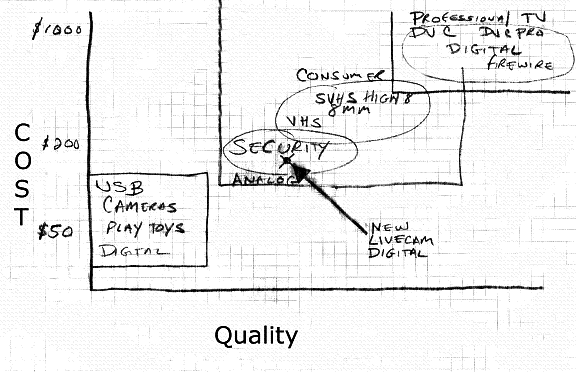
Figure (2) Cost of video camera vs. image quality

Currently in the Medium quality, mid-range there only exists analog video systems. Digital is both low cost and low quality or high cost ultra high quality with little in the middle ground. There seems to be no digital solution with adequate quality for security camera use and that is still cost effective. 

            This is where I plan to place the new Livecam camera product, the only midrange digital solution that beats the “disposable USB Cameras” and provides an industrial grade security solution while still being sellable into business and consumer markets for a higher quality of video conferencing then is available today.

            Even if the low cost cameras like the USB or a connectix QuickCam deliver better video it’s not compressed output and they require a $1000 Windows PC to connect to and convert the video into an Internet format. Currently it’s only the very high end DVC equipment that included the video compression electronics to be able to save 1 Hr of digital video to a tape.


The Wireless World



Figure (3) Xcam2 Wireless Video Camera with built-in Video Transmitter

Product Misperceptions

The X10 camera that has been seen all over the web with these new annoying pop up from behind ads. There are great little cameras, but they are not digital. These X10 cameras are analog video cameras with analog wireless radio links and have nothing to do with the Internet video. They are another security product that is selling like crazy. It’s one of the few consumer grade security products and before their very effective Internet marketing blitz they were having a very difficult time selling them.

It’s funny because most people perceptions still are they can send video over the Internet with the Xcam2 product. To do this you will still need to use a Livecam or similar to convert and compress the video to a Internet format. I have used these X10 cameras with the Livecam on many occasions to eliminate having to dangle wires across a room or get into difficult to access locations.

Importance of Wireless

This brings up a very valid point. Wireless is an important technology and can simplify the installation of surveillance systems to a large extent. The new Livecam product is designed to connect to standard Ethernet networks.  There is an 802.11 wireless Ethernet standard that is very quickly dropping in price and increasing in popularity. Some future models of the Livecam camera will have 802.11 (DSSS, wireless Ethernet) support build in thereby being 100% identical in operation to the wired version but operating wireless. In this version a third Party wireless card will just be added internally to the camera.
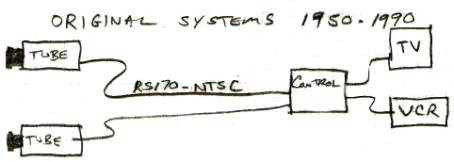


Figure (4) Older CCTV (Closed Circuit Television System)

Cameras technologies have improved over time.
  1. Black and white tube
  2. Color multiple tubes
  3. Color single tube
  4. Black and while CCD (Charge Coupled Device) a silicon chip
  5. Color CCD
Coming soon is:
  1. Color CMOS – cameras build using digital silicon chip process
  2. Color CMOS all digital output, USB cameras do this now but the image quality is not there yet.

The technology for 6 and 7 is still being worked out, I would very much see this company eventually make a #7 based product where there is nothing but a chip with a lens and network connections coming out of it. This would be the ultimate in low cost.

Until the mid 80’s there was little improvement in the rest of the system.
VCR’s came in the 70’s but these are just modified consumer VCR’s that move the tape slower and cause severe reduction in picture quality. Most systems still use this.

Also the addition of a control/effect box allowed one TV to display 4 cameras at one and also allow the rotation of multiple camera images to cycle through an even larger number of attached cameras. 
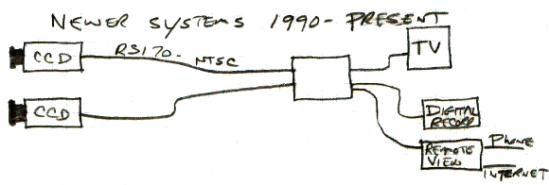
Figure (5) Current CCTV systems

More recently digital recorders have become available. These are like the consumer TiVo product that store compressed video on a hard disk drive. These units can run from $1200 to $20,000. Most are based on Intel PC computers and some even run windows inside.

Most of the lower cost recorders claim full motion and support for several cameras at once, but when evaluating these I found as soon as you have more then one camera the video drops to a image per second or lower. This is more like a slide show.

Most will not transmit video over the Internet and there are separate boxes that support this.  The older Livecam product can be consider one of these, even though it has superior image video quality then the competition, its higher price, larger size and appearance as a desktop PC has limited sales into the security industry.  The new Livecam camera rectifies all of these issues.


Figure (6) Livecam Camera in and All Digital CCTV Security System

  • A – All Digital Cameras connected directly to network.

  • B – Typical Ethernet LAN Hub to interconnect all network devices.

  • C -- Windows Based PC can allow viewing of cameras or recording

  • D – Unix server can allow conversion of digital video to Analog TV and also record digital video.

  • E – A standard TV or Analog CCTV Security Monitor or Computer VGA Monitor

  • F – Same as D except connected over the public Internet
  • G – Same as C except connected over the public Internet


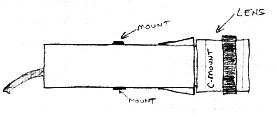
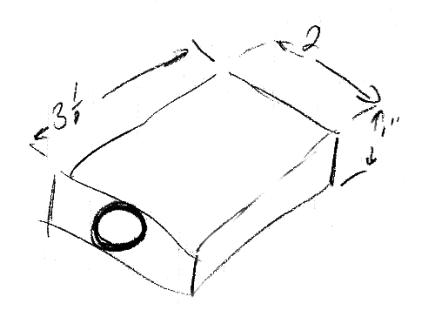
Size of proposed new video solution. In Inches.
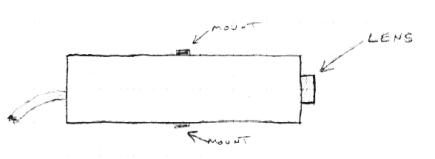

Version with built-in cheap plastic lens.
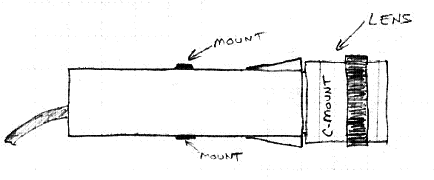
C-mount removable lens version. Customers can select their own lenses.
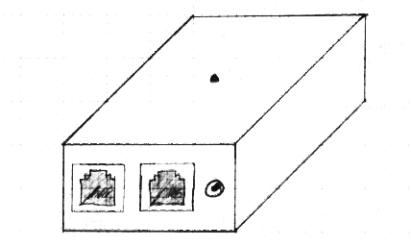

Rear view of unit, Notice 2 x 10-BaseT Ethernet Network connectors and power.
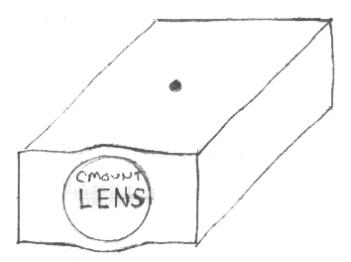

Front view of C-mount version.
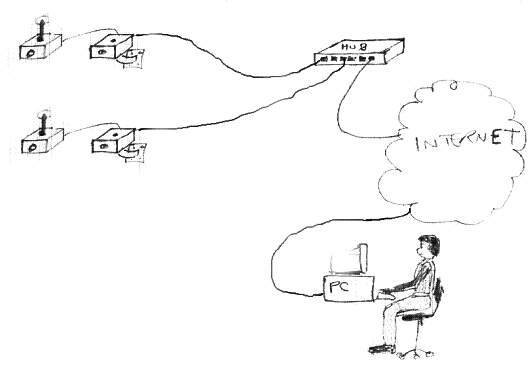

This is a bad drawing I did to show a typical system setup.
Notice how the cameras are in a daisy chained or start configuration and attach them directly to a network hub and directly onto the Internet.


Articles:

 Just a Search for the word “Surveillance” in Red Herring still needs to be filtered.


Date and Source
Title
Topic Area
09/19/2001   Red Herring
Catch of the Day
09/11/2001   Red Herring
Technology
08/06/2001   Red Herring
Investor
08/01/2001   Red Herring
Magazine
05/01/2001   Red Herring
Venture Capital
04/27/2001   Red Herring
Venture Capital
04/25/2001   Red Herring
Venture Capital
04/23/2001   Red Herring
Venture Capital
04/20/2001   Red Herring
Venture Capital
04/11/2001   Red Herring
Investor
04/03/2001   Red Herring
Venture Capital
02/15/2001   Red Herring
Technology
02/06/2001   Red Herring
Venture Capital
01/18/2001   Red Herring
Technology
01/16/2001   Red Herring
Technology
01/01/2001   Red Herring
Technology
11/20/2000   Red Herring
Venture Capital
11/01/2000   Red Herring
Magazine
11/01/2000   Red Herring
Magazine
10/16/2000   Red Herring
Venture Capital
09/19/2000   Red Herring
Venture Capital
08/01/2000   Red Herring
Magazine
05/01/2000   Red Herring
Magazine
03/01/2000   Red Herring
Magazine
01/01/2000   Red Herring
Magazine
04/01/1999   Red Herring
Magazine
03/01/1998   Red Herring
Magazine
01/01/1998   Red Herring
Magazine
12/01/1997   Red Herring
Magazine
12/01/1997   Red Herring
Magazine
08/01/1997   Red Herring
Magazine
08/01/1995   Red Herring
Magazine
07/01/1995   Red Herring
Magazine
04/01/1995   Red Herring
Magazine


COMPANIES
redotVisionics (face recognition)
redotViisage (face recognition)
redotIdentix (fingerprint recognition)
redotIridian Technologies (iris recognition)
redotEyeTicket (iris recognition)
redotKeyware (various biometrics)
redotBioNetrix (biometrics application platform)
redotAnkari (security and authentication)
redotRSA Security (authentication and data security)

Appendix

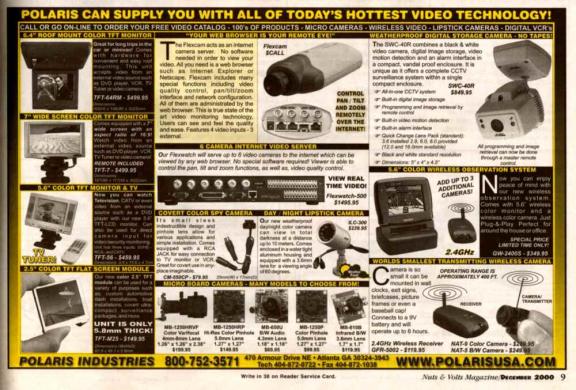
Adds  of other competing technologies.
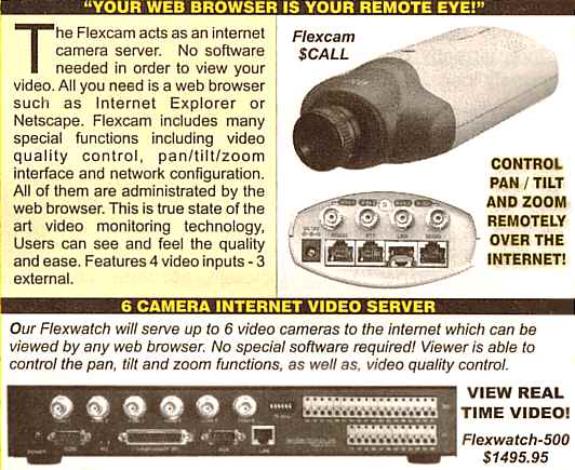


The Livecam in this page is the old Zydeo Livecam product.


Video Streaming Basics
WHAT IS VIDEO STREAMING?
Before video streaming, you had to download an entire video file onto your hard drive before you could watch it. This usually involved a long wait. With video streaming, you only need to download a small portion of the same video file before you can watch it online. Although image and sound is still not television quality, you do have instant access to information.

LIVE VIDEOS AND ARCHIVED VIDEOS
Streaming media can be a live experience--actual broadcast time. It can also be an archived video that is stored on a server that you can view anytime. For archived video, you need a camcorder to shoot original material and you need to edit it before broadcasting it. If you are going to capture your own video footage, because of compression and decompression you should limit movement, avoid zooming, simplify backgrounds and get close to the subject matter.

COMPRESSION AND DECOMPRESSION
A video file starts its journey as an analog signal, then becomes a digital file and finally, converts back to an analog output. Basically, the analog signal is sent from a video camera to the transmitting server to be encoded and compressed into the digital file before it is sent via the Internet through a FTP (File Transfer Protocol). When the digital video reaches your computer, it is decoded and decompressed back into an analog signal before you can view it.


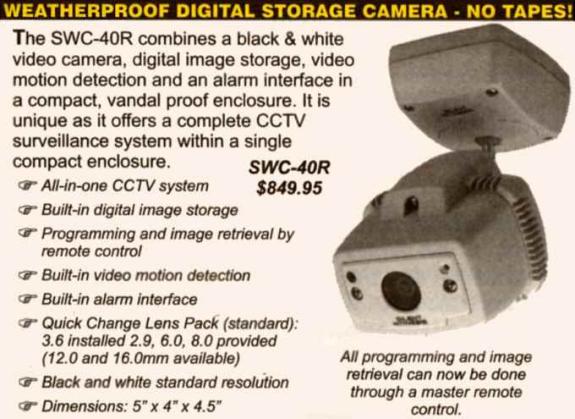
WEBEYE ALL-IN-ONE HIGH SPEED CAMERA SERVER
Only: $719.00 USD
The WE-10 is an integrated camera and video streaming server all in one attractive unit. Provides full remote access via internet.      


VPON 4 CHANNEL AUDIO/VIDEO WEB SERVER
Only: $1,979.00 USD
The new VPON-300 remote video web camera server supports full motion live video and full two way audio transmission via the Internet, Intranet, or direct dial-up modem connection      


LIVECAM 1.0 VIDEO/AUDIO STREAMING SERVER
Only: $5,995.00 USD
The broadcast quality LSX-01 audio/video streaming server operates without the need for plug-ins or media player - ideal for video conferencing applications.      


LIVECAM 1.0 VIDEO/AUDIO STREAMING SERVER [LSX-01]
The OPTICOM LSX-01 is a broadcast quality streaming audio/video server. With Broadband Technology becoming a dominant force in the marketplace, it is important to make sure that users are able to utilize technology like the LSX-01. Because the LiveCam video stream is actually Live, and the applet is delivered concurrently with the stream, the LiveCam video stream can be utilized in unique ways currently unachievable with traditional streaming systems.
  • Broadcast Quality Streaming of Any Video Feed via Internet or Intranet
  • Complete Audio/Video Streaming System
  • True Real Time Viewing - No Buffering
  • Linux-based PC/Server Technology
  • Proprietary Compression Algorithm
  • Easily Embedded into Existing Websites or Emails
  • No Need for Additional Software Plug-Ins or Media Player
  • Scaleable Original Image Size (320 x 240)
  • Up to 100 Simultaneous Users with No Frame Rate Loss
  • Compatible with Cross O/S Platforms Including MS and Mac
  • Real Time Audio/Video Provides Video Conferencing via Internet
The LiveCam operates on cross platform, all makes of PC's and Apple/Mac computers can accept and view the stream. Live video and audio can be e-mailed to opt-in mailing lists, allowing the user to see video right from their Eudora or Outlook Express mail program.

The LiveCam can be used as a powerful marketing tool as the stream can be integrated into hundreds of banner adds across the web to increase click-throughs and regular site visits. The LiveCam will support hundreds of simultaneous users with no video or audio loss. The "real-time" aspect also allows for web based "interactivity" on a new level: Remote control devices, mass internet marketing, and videoconferencing are just a few examples.


WEBEYE ALL-IN-ONE HIGH SPEED CAMERA SERVER [WE-10]
The Webeye™ WE-10 is an integrated camera and video streaming server all in one attractive unit. The Linux based Web-server combines high speed networking technology with a 1/3" format CCD camera. In addition to this, the WE-10 is equipped with a 32bit RISC CPU, making it even more efficient in processing images. The WE-10 utilizes a High-Speed Internet connection (ie. Cable modem, ADSL, T-1) by connecting directly into the Ethernet and providing live motion color pictures via the Internet.
  • Superior Wavelet Compression Algorithm
  • Maximum 30 Frames per second (FPS) Image Compression
  • High Resolution Images (720 x 486 NTSC, 720 x 576 PAL)
  • Maximum 30 FPS High Resolution Image Transmission
  • Provides 100 Simultaneous User Accessibilty
  • Motion Detection Alarm w/Off-Site Notification
  • Supports Remote Pan/Tilt/Zoom Control
  • External Sensor Input and Solid State Relay
  • External Video Input via RS232~RCA Adaptor
  • Focus Area Selection and Setting
  • Adjustable Image Compression and Decompression Rates
  • 6MB Configurable Web Page, Self-contained FTP Server and Email Functions
  • Supports TCP/IP, ARP, RARP, ICMP, DHCP, FTP, HTTP, and SMTP Protocol
The WE-10 generates pictures in Wavelet format, which is a more efficient, by 30-300%, compression system than standard JPEG. By utilizing the Internet, the user can save expensive long-distance charges often associated with PSTN modem-to-modem dial-up connections, while still able to have real-time monitoring of live video.


This lists “which is a more efficient, by 30-300%, compression system than standard JPEG”
In tests this is much less efficient then the original Livecam product requiring more bandwidth to achieve the same frame rates and image quality then Livecam was using.  In addition they have a low profit margin because they have had to embed and entire windows PC inside their camera.


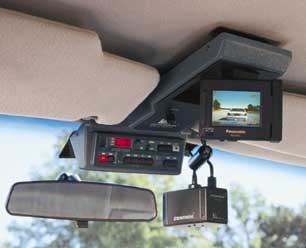
EYEWITNESS® In-Car Video System
Your job becomes a little easier with Eyewitness. Recognized as the number one in-car video system of choice by law enforcement agencies worldwide, it is easy to see why so many officers have come to rely on their Eyewitness systems.
Designed for constant use, the system features top-of-the-line, industrial-grade components, including a Panasonic recorder and Sony camera. Be sure to check out the wide range of features that continue to make Eyewitness the most preferred in-car video system on the market.
To request a product quote online, you must be a Preferred Kustomer.


   » Products » Network Camera and Video Servers 

Network Camera and Video Servers
Axis Network Cameras and Video Servers provide an easy way to capture and distribute live images over a network or the Internet using a standard web browser. Whether you want to enhance your web pages with live images and sound, or if you need a network surveillance solution, Axis can match your needs. 


Wednesday, April 03, 2019

The Dangers of AI, how to ensure our future generations


If you follow Elon Musk on his predictions on the dangers of AI, the most sure fire way to ensure our future generations is to prepare them.

Currently our educators and the system is unprepared for this unprecedented change.
Which is why it's important to start this conversation now.

The curiosity Artificial Intelligence in Education conference April 12, in San Jose.


Thursday, November 01, 2018

Good Silicon Valley Machinist.


This isn't an advertisement and I don't often recommend people.
But finding a good Machinist in Silicon Valley can be difficult.


I am posting a recommendation for

Ramon Zamora of https://www.ldmmachiningca.com/
650-207-5090
His shop is located in Newark.

We had a decent conversation and he showed me his work.


Friday, September 21, 2018

My post from 1995 - Internet office space in Venice for rent

Internet office space in Venice for rent 
Author: Jesus Monroy Jr<jmonroy@netcom.com>
Date: 1995/09/09 
Forums: la.general, la.wanted, la.forsale 
Posted on: 1995/09/09

followup-to: sokol@reyes.stanford.edu 
keywords: LA intnet office rent beach venice T1 
organization: NETCOM On-line Communication Services (408 261-4700) 
sender: jmonroy@netcom.netcom.com

INTERNET ACCESS INTERNET ACCESS INTERNET ACCESS INTERNET ACCESS INTERNET
OFFICE         SPACE      FOR             RENT             IN VENICE
                                                           IN VENICE
OFFICE        SPACE     FOR                 RENT           IN VENICE
                                                           IN VENICE
OFFICE        SPACE       FOR                       RENT   IN VENICE
                            Starting at $200-300
ABBOT KINNEY ABBOT KINNEY ABBOT KINNEY ABBOT KINNEY ABBOT KINNEY ABBOT KINNEY
   You have always imagined working with other  COMPUTER
   professionals
   The SYNERGY, the energy, the excitement of CREATING
   something new.
   You also want to remain independent.  NOW there this is
   space where this is happening.
Where?  In VENICE, on Abbot Kinney  in a FUNKY old building
with  lots of character resides a professional office space.
It is nestled in a complex with restaurants, cafes and a
sculpture garden with pond.  The office is connected with
the CYBER-JAVA Cafe.  The first commerical electronic cafe
in L.A. Imagine enjoying a cappuccino or taking your
CUSTOMERS down to the back patio for iced lattes.  If that
isn't tempting enough let me describe the space.
After entering a LIGHT SANDSTONE fascade you go up to the
first floor. A light open beamed room welcomes you with lots
of northern light. The space is divided into 5 rigid wall
CUBICLES. There is a kitchen, shared PRINTER, bathroom and
backroom.
The cubicles are GENEROUSLY sized at 1: 68.5" X 68.5" facing N
                                     2: 134'' X 99"          N
                                     3: 48.5" X 99"          W
                                     4: 86"   X 65"          S
                                     5: 134"  X 86":         N
   Security it available and adjoining cubicles or blocks are
   POSSIBLE for partners. Isn't is time you THOUGHT about
   taking the NEXT STEP in you companies growth?
The BIGGEST benefit might be your access to a high speed
internet connection.  We share a T1 line with the Cafe next
door. You could be racing  on the Net, surfing for
customers, or downloading files. It could definitely be THE
reason to move out of the home office and rent here.
So meet your fellow professionals on A.K. (Abbot Kinney).
    We are just off Main between Rose and Washington in Venice and
    mere blocks from the beach. Three in fact and the
    boardwalk. Nothing like a little sun to tide you over
    till the weekend.
    Security it available and adjoining cubicles or blocks are
    POSSIBLE for partners. Isn't is time you THOUGHT about
    taking the NEXT STEP in you companies growth?

RENT $200-300  FOR MORE INFORMATION CALL ANN OR JOHN AT (310)452-2046 For
Further info send E-mail to sokol@reyes.stanford.edu and check out
http://www.cyberjava.com for the Cafe next door.

Wednesday, September 12, 2018

Luminar Lidar team photos

From my time there in 2017


Sent from my iPad

Monday, September 10, 2018

Tuesday, August 28, 2018

In the news again. Chinese-language Internet portal (www.tom.com)


http://news.tom.com/201808/4055489485.html  (translated using Google)

51Talk Stars small player American study "radish too spicy" technology company personally assembled robot super excited


2018-08-09 10:55TOM
After feeling the free and inclusive academic atmosphere of Berkeley University and visiting the technology Google and Apple, the second season 51Talk Star National English Small Talent Show broke out and the small players started a new study tour. This station they came to the robot education company RoboTerra (Chinese name: radish too spicy) founded in Silicon Valley, USA, co-founded by Columbia University and Stanford University alumni. In addition to a comprehensive understanding of this new technology company, the small players also had in-depth communication with computer experts, and under their guidance, assembled a personalized robot. Seeing the robots that I made by myself, the little players shouted "Crazy!" excitedly.
The small players Dongye Yiyi, Qi Guanyi and Wang Yuanyi discuss robot knowledge with computer expert John Sokol
51Talk Star and technology rookie hit a different spark
RoboTerra is a STEAM education company based on professional programming learning and robot manufacturing in C language. In addition to having a very international entrepreneurial team background, there is also a special Chinese name called radish too spicy. Although less than five years old, RoboTerra is well known in the technology education industry. The radish is too spicy to provide a global robot education platform for students, teachers and educational institutions to stimulate their creative potential and enhance their overall quality. At the same time, it also provides robot education including teacher training, laboratory construction programs and events. solution.
In the radish is too spicy, the small players are attracted by a variety of novel elements. "I didn't expect to see robots in TV movies, I can do it myself!" Wang Xiaoyi, a small group champion, Xiao Guan, a small group runner, Xiao Gao The runner-up Dongye was in a good position. The three children and the experts communicated in English all the time. From time to time, they were amused by the humorous John Sokol. Under the explanation and guidance of John Sokol, the children started, built and debugged their own "freestyle" robot.


The small players are interested in robots.
Interest-oriented + learning to use = maximizing learning outcomes
"RoboTerra has many similarities with 51Talk. For example, the service targets are mainly young people, and the educational concepts have similarities. They are actively using technology to improve education. On the other hand, they hope that small players can appreciate the beauty of technology through communication with foreign teachers. I will learn the changes that I will bring to my own English.” The head of the 51Talk Study Tour talked about the reasons for choosing RoboTerra as an important stop for the study tour. He believes that the study tour should focus on diversity, with top-ranking universities, established large-scale technology companies, and of course should include technology rookies, and strive to make children worthwhile.
The little contestant Wang Yuanyi’s father lamented, “From Google to Apple, while experiencing the latest technology in Silicon Valley, I also appreciate the spirit of Silicon Valley, which returns to the essence of life, maintains a normal heart, and exerts creativity. Today, in the radish and spicy company, Computer scientists introduced to children that the evolution of robots reflects the progress of human civilization. The creativity and wisdom of various robots make us all amazed! 51Talk's study tour has benefited children." The radish is too spicy, and it is also a stage test of the English learning effect of the small players. In the process of communicating with foreign experts, the fluent oral expression of the small players is very gratifying to the parents and staff present.


51Talk Vice President Dai Yun (first from left) and the small players and parents in the radish too spicy
It is understood that the unique low cost advantage of 51Talk Philippine foreign teachers allows many ordinary users to enjoy high frequency and high quality English courses. In order to meet the law of adolescents' cognitive development, 51Talk also provides rich and interesting interactive forms and instant reward feedback for the classroom through AI technology, which fully motivates children's classroom learning enthusiasm and allows children to speak English. In fact, many practitioners dedicated to adolescent education have seen the importance of interest and application for their children's learning. The educational institutions represented by radish and spicy, 51Talk have already begun to run on the road of practicing quality education. With effective and interesting keywords, we will create a better education platform for children and strive to open a dialogue world and beautiful for children. The door to the future.


Tuesday, August 14, 2018

Micro:bit getting more resolution on led array


Microbit Gaussian LED bounce

https://github.com/johnsokol/microbit


# Add your Python code here. E.g.

from microbit import *
import math
image = Image("90009:"
              "12345:"
              "56790:"
              "02468:"
              "90009")

wid = 1.2

#for ctx in range(0, 50):
# for cty in range(0, 50):

xv = 3.3
yv = 4.1
xlim = 5
ylim = 5
ctx = xlim
cty = ylim

while True:
    ctx += xv
    cty += yv
    if ctx > (50-xlim):
        xv = -xv
    if ctx < xlim :
        xv = -xv
    if cty > (50-ylim) :
        yv = -yv
    if cty < ylim :
        yv = -yv

    tx = ctx / 10
    ty = cty / 10    str1 = ""
    for x in range(0, 5):
        for y in range(0, 5):
            pix = int(math.exp( -pow(x-tx,2)/wid )* math.exp( -pow(y-ty,2)/wid ) * 9)
# str1 += str(x+y)

            str1 += str(pix)        if x < 4:
            str1 += ":"
    image = Image(str1)    display.show(image, delay=0, wait=True, loop=False, clear=False)

#print (str1)

Wednesday, February 07, 2018

OpenSecret - Unforgeable proof of document authenticity. Digital Fingerprints

John L. Sokol  &  Aryeh Friedman  May 3, 2008

(OpenSecret is only a temporary working name)


SUMMARY:
   Unforgeable proof of document authenticity.  Digital Fingerprints of a electronic documents.


https://docs.google.com/document/d/e/2PACX-1vT8zx2H6On175JXI3Y1szdiTDWKs803QrEoAYNx6mMR4ErRs8mpws3_IQF6_rlBdIH9xUVSHuBy18sN/pub?embedded=false

VR/AR system - Product Proposal from Jan 2011

VR/AR system.  - https://docs.google.com/document/d/e/2PACX-1vRgoDtwTT6TZrJRVk_oJ6I7y8vUk-xnhu67rI9kywZV2jRMA5Siz0cG9HdhFPk7grP_IKvuywg1VYn1/pub

3D VR / AR system.
John Sokol  Jan 2011
I am just planning to keep this one really really simple.  Either they fund it or they don't.  But just take what's off the shelf and bridge it to what already exists in the software world.
As they say "Flip it" meaning just do one thing, make money and sell it off, go on to the next. Not get too emotionally involved.  
Yes some passion, it's very cool stuff.  I think a low cost 3D display device that's cheaper than buying a home 3D setup and more flexible in its capabilities.  But this is just a small stepping stone to where I want to get.
The unit consists of 2 Micro LCD display with 3D graphics, and can be embedded into a pair of video glasses.  Specifically the display would be the:  http://www.kopin.com/bdm-922k/  driven by an NVIDIA Tegra 3 chip.

The device should be able to play 3D movies and render 3D graphics for games and other applications located on people PC’s or Phone as well as be able to run applications stand alone.
Back in the late 80’s Virtual Reality was the next big thing.  Companies like VPL were able to partner with Sun and SGI in making commercial Virtual Reality systems. Some companies even tried to bring this technology to consumers with 3D VR gaming systems that people would pay $20 just to try for 10 minutes.
It’s has also been the centerpiece of many TV shows from the Star Trek Holodeck to the more recent Battlestar Galactica spin off Caprica and for movies like Lawnmower man, Tron and Avatar.
Since then Augmented reality has also come into popularity. This is where the virtual world and the real world are mixed also known as Mixed reality.  This allow you to see the real world with computer graphics superimposed over it, like showing in Terminator, Robocop and the binoculars used in Star wars. Today this is primarily in the form of smartphone apps that display animated characters over QR codes.
We are starting to see some of the first signed of this technology begin to reach the market with the Wii Mote and the XBox Kinect and other gesture recognition systems that have yet to reach the market.
Here we are today in 2011, and with Moore’s law, the prices of technology have dropped while the capabilities have soared to new heights since  1990’s.
  • Low cost head worn video displays are readily available from China to watch video from your iPod with.
  • Cell phone have low cost Dual core 1 Ghz CPU’s and graphics accelerators.
  • 3D Content is starting to gain market traction and 3D TV’s are available in stores.
  • 3D BlueRay, 3D Netflix, 3D Youtube and a bunch of new 3D cameras and Cell phones are making 3D a permanent part of the market.
Today there is not one consumer level 3D headsets, although 3D Glasses are common that work in conjunction with special displays and TV’s.
Not  one company makes a mass consumer VR or AR products.
What I propose is to make a $300 to $500 retail price, portable, mobile VR / AR / 3D Video headset.
  • 3D movies can be viewed in private.
  • Virtual reality multiplayer 3D games can be played.
  • The device can wirelessly communicate with laptops and mobile phones to take advantage of the phones communication , storage and processing power.
  • Augmented reality application and games will change the world, there are many developers and some amazing applications for phones but no hardware is available to do the full 3D immersion versions of it.
  • The device can be interfaced to exercise equipment so a run on the treadmill can turn in to a run on the beach in Maui.  And stationary bike can be the tour de france. The applications for game in this area can be huge.,
  • Remote control of AUV’s and other telepresence application that allow the viewer to see in 3D and respond to the wearers head movement.
Using off the shelf optics assembly and doing a custom PCB with CPU’s it is possible to take one of these video goggles to a whole new level.
With such a device 3D immersion into existing PC based games can be done.
Support for 3D graphics in HTML5 on the display, allowing for a 3D web experience.
Support for existing VR/AR applications.
To define a standard for the next generation of these applications to run on.

SPECS

Hardware

2x  720x480 full color displays.    http://www.kopin.com/bdm-922k/ 
Nvidia Tegra 2 or Tegra 3 GPU. Multi Core Arm Processor with Graphic Acceleration.
Stereo Audio & Video
Support of WiFi and BlueTooth.
2 Camera Modules  (option to provide Stereo Video Input for AR applications, improved tracking etc.)
3 Axis motion and gyro
ADXL330 3-axis accelerometer
MPU-6000/6050: World’s First Integrated 3-Axis Gyro, 3-Axis Accel and 9-Axis MotionFusion http://invensense.com/mems/gyro/mpu6000.html
Lithium Ion Batteries.
* Possible inclusion of separate external 3D spatial Controller, like Wii Mote or similar. with BlueTooth Interface.
Initial prototype could be build with off the shelf Tegra 2 dev board:

Software

Webkit
HTML5
OpenGL, WebGL
Arm Linux
LLVM
Video Streaming in and out of Stereo Video in MPEG2 and MPEG4 AVC, H.264
The main software is designed to run stand along to the web using WiFi or act as a slave device to a cell phone or PC that is doing graphics rendering.
Surfing a 3D web experience with 3D icons is already possible with current 3D setups on PC, this will all work on this device also and could make for a much richer 3D web experience.

Wednesday, October 11, 2017

Fwd: Podcast on Hacker Dojo


---------- Forwarded message ----------
From: "Chad Hall" <randombadassery>
Date: Oct 10, 2017 7:05 PM
Subject: Podcast on Hacker Dojo
To:
Cc:

Wanted to send over the link to the podcast episode, as promised. I think you'll really enjoy it. Thank you again for helping us with this. It was completely our pleasure to see what a great place you guys have at Hacker Dojo.  

Please share with whoever you you think will enjoy it. 


https://creativeminds.fireside.fm/31    (NEW LINK)


—CH—
Random Badassery


Sent from my iPhone

Thursday, September 28, 2017

Saturday, July 22, 2017

Mentioned in Atari podcast.

ANTIC Interview 264 - Paul Cubbage, Atari Program Exchange

http://ataripodcast.libsyn.com/antic-interview-264-paul-cubbage-atari-program-exchange

I am mentioned in the post cast 7:40 in where I did a 7 days without sleep stint for a contract with Sun Micro systems.
And again 1:34:00 in about my streaming video and Timothy Leary and Arthur C. Clarke.

He also mentions Chris Crawford's SCRAM nuclear reactor simulator at 15:00 in.
https://www.youtube.com/watch?v=B3XiR5tYhFo

https://en.wikipedia.org/wiki/Scram_(video_game)

Monday, April 03, 2017

Internet of things, everyone keeps thinking sensor

Internet of things, everyone keeps thinking sensor nets.
It's the Internet of atoms, matter , things.
Internet of transportation is a more apt term.
When material objects are moved like we do data today. Stored, sorted, organized, processed, transportation, packetized and serialized.
Uber with self driving cars. Automatic farms, factories, transportation, food preparation.
With cheap solar, and wind everything changes.
Flying cars become viable and aluminum cheaper yet.
Robots will cost nearly nothing to operate.
Humans could have the highest standards of living yet.
Or lowest yet as jobseekers will search endlessly in vain.
Either could be perilous for the largest population of humans in history.
There was something called the rat utopia experiment. This is one is which the rats were given everything they could ever want without struggling. Food, water space,
Soon the population experienced a social break down so severe they went to total population extinction. The researchers were horrified by what behaviors they witnessed.
We are also at start of an explosive growth in medical advancements and life extension that may make people virtually immortal.
Who wins who looses. If the selfish win, the machines will mimic this, it will be unavoidable and repeat this till no human being exist.
Or if we choose different optimization parameters those will be mimic forwards into the future. Maybe some comfortable middle path averting both undesirable outcomes.


Sent from my iPad